
A catalogue of brand names and molecule names is not enough to decide whether a veterinary portfolio is safe, legal, useful, or profitable. By the end, you will have a screening method for species fit, clinical information, documentation, landed cost, and portfolio balance before placing a franchise order.
Key takeaways
- Map products by species, indication, formulation, route, and sales channel.
- Ask for licence copies, batch records, labels, and certificates before listing products.
- Compare treatment cost, not pack price, across doses and course length.
- Build a balanced portfolio that supports safe use and repeat orders.
Start by sorting every product into a usable portfolio map
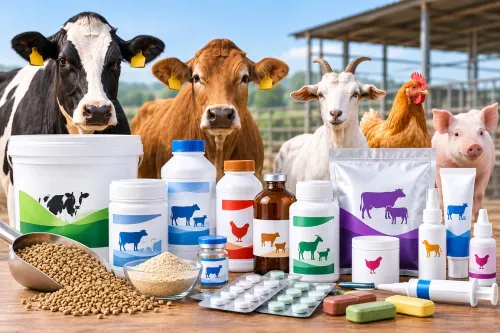
Separate the catalogue into portfolio groups before judging whether any individual product deserves distribution. A pcd pharma franchise product list veterinary becomes usable only when each entry shows where it fits: animal, clinical purpose, formulation, administration route, prescription status, and sales channel.
1. Create species columns for dogs, cats, cattle, buffaloes, sheep, goats, and horses. Mark products as single-species, multi-species, or unspecified; an unspecified target is a review hold, not a broad-use assumption.
2. Within each species, sort by indication such as infection, pain and inflammation, parasites, reproductive care, nutrition, or wound management. Keep prevention, treatment, and supportive care in separate groups so they are not compared as substitutes.
3. Split each group by dosage form and route: oral tablet, bolus, powder, suspension, topical preparation, intramuscular injection, subcutaneous injection, or intravenous injection. Record dose basis, treatment duration, repeat dosing, injection volume, diluent or preservative needs, and storage condition.
4. Add commercial and channel tags: prescription-only, clinic use, farm supply, pet retail, or feed-linked sale. Flag products that lack an active ingredient, strength, pack size, shelf life, withdrawal period, or package insert; do not score those entries yet.
Finish the map with a “local fit” column. Record the animals actually served, common indications, available veterinary supervision, cold-chain capacity, and expected pack movement. This prevents a long catalogue from hiding gaps in the few product groups your territory can sell repeatedly.
Check the label, licence, and batch evidence behind each entry
Reject any entry that cannot be tied to a named product, licensed manufacturer, and identifiable batch. The label must state the generic name, active strength, dosage form, pack size, target species, route, storage temperature, shelf life, batch number, manufacturing date, expiry date, and manufacturer’s name and address.
Ask the veterinary pharmaceutical manufacturer for distributors for these records:
- A copy of the applicable Indian manufacturing licence, including licence number, licensed site address, and the products or dosage forms it covers.
- Evidence that the manufacturing site follows the relevant GMP requirements; an ISO certificate alone is not a substitute for a drug licence.
- The package insert showing indications, dose basis, duration, contraindications, adverse effects, interactions, prescription status, and administration instructions.
- A batch-specific certificate of analysis matching the batch number, plus storage conditions and a named complaint or recall contact.
- For food-producing animals, the approved withdrawal period by species, dose, route, and commodity; never infer it from a human medicine or another animal species.
| Evidence | Verify on the document | Reject when |
|---|---|---|
| Label | Generic name, strength, form, species, route, batch and expiry | Details are missing or inconsistent |
| Licence | Manufacturer, site, licence number and authorised product | Only a catalogue or ISO certificate is supplied |
| Certificate of analysis | Batch number and test results match the pack | It is a generic factory certificate |
| Package insert | Dose, safety limits and withdrawal period | Claims exceed the approved label |
For antibiotics, verify the active ingredient and antimicrobial class rather than accepting “broad spectrum” as evidence. A human presentation is not automatically suitable for dogs, cats, cattle, poultry, or aquaculture species.
Test species fit, clinical use, and safety controls
Reject an entry if its label cannot match the animals, indication, route, and safety controls in your market. Compare the label with the species actually treated, not with the brand name or a human equivalent.
- Record the generic name, active strength, dosage form, pack size, storage temperature, shelf life, and package insert.
- Match the target species and indication; reject vague claims such as “for all animals” or “broad spectrum” without approved detail.
- Confirm the dose basis, route, injection volume, preservative or diluent requirement, and species-specific presentation.
- Check contraindications, adverse effects, interactions, treatment duration, repeat dosing, prescription status, and when examination is required.
- For food-producing animals, verify the withdrawal period by species, dose, route, and edible tissue; “safe” does not prove residue compliance.
- Confirm a fixed-dose combination’s strength, species, indication, route, and withdrawal period are authorised; approval of each ingredient separately is not enough.
- Review antibiotics by active ingredient and antimicrobial class, not brand claims, and reject routine prophylaxis messaging without veterinary oversight.
Do not substitute intravenous use for intramuscular or subcutaneous use: absorption and tissue irritation can change. Human and veterinary presentations of the same molecule are not interchangeable because metabolism and dosing interval differ. Excipients and permitted routes can also make the human label unsuitable for the target animal.
Calculate veterinary franchise products and pricing by treatment cost
Compare each option by the cost of a complete treatment for one animal, not by the price printed on a bottle or carton. Veterinary franchise products and pricing become comparable only after you match species, indication, dose, route, treatment length, concentration and pack size.
| Option | Calculation | What it reveals |
|---|---|---|
| Bottle price | Pack price ÷ labelled volume or units | Purchasing cost only |
| Dose cost | Price per ml or tablet × dose volume or units | Cost of one administration |
| Course cost | Dose cost × number of doses | Cost for one complete treatment |
| Landed course cost | Course cost + allocated freight, tax, cold-chain cost and pack wastage | Actual commercial comparison |
Include unopened remainder when a pack cannot be used before expiry. Add the cost of refrigeration for products stored at 2–8°C. Record minimum-order quantities and scheme stock separately instead of treating free units as permanent margin.
Separate three figures in the quotation: manufacturer transfer price, your landed cost and the proposed customer price. Then test the claimed margin after transport, tax, credit-period financing and unsold stock. Ask specifically about:
- Territory exclusivity and minimum order value
- Promotional stock, expiry replacement and damaged-goods credit
- Freight responsibility and cold-chain delivery evidence
- Credit period, payment terms and scheme conditions
Do not substitute a human presentation or a different veterinary brand solely because the molecule matches. Compare approved species, strength, excipients, route, dosing interval, withdrawal period and prescription status; a cheaper product is not an alternative if its label does not cover the animal or indication.
Choose a balanced list that can turn stock into repeat business
A portfolio is worth discussing when local orders show repeat demand across species, indications, and pack sizes rather than one attractive product. Track enquiries, prescriptions, invoices, repeat orders, average monthly units, and days of stock for each entry in your pcd pharma franchise product list veterinary.
| Signal | Measure | Warning sign |
|---|---|---|
| Demand spread | Orders by species, indication, route, and customer type over 8–12 weeks | Sales depend on one clinic, one season, or one molecule |
| Stock movement | Monthly units sold ÷ average units held; record days to sell each pack | Slow movement leaves short-dated or expired stock |
| Pack fit | Compare pack size with typical cases and treatment duration | Large livestock packs move poorly in pet clinics, or small packs raise treatment cost |
| Commercial return | Landed cost plus tax, freight, financing, and wastage versus customer price | Quoted margin disappears through minimum orders or transport |
| Repeat business | Reorder rate and interval by account | Customers buy once but do not repeat within the expected treatment cycle |
Discuss the range with a veterinary pharmaceutical manufacturer for distributors when at least two demand segments reorder and the portfolio covers complementary products without duplicating the same indication. Ask for minimum order quantity, credit period, expiry replacement, temperature-exposure returns, and territory terms in writing.
Alvid Groups can be assessed by the same evidence: compare batch-specific certificates of analysis, product licences, storage instructions, and a named complaint or recall contact against the commercial offer. A generic factory certificate does not prove that each batch is saleable.
Related products
 | Pet Division The product in the image is Helmikill-Pet Tablets, a broad-spectrum deworming medication for dogs and cats. View product → |
 | Pet Division SCABAN-PЕТ Scaban-Pet Shampoo is a medicated topical treatment for dogs and cats formulated to manage various skin conditions. It is manufactured by Alvid Pet. |
Frequently asked questions
How should you sort a veterinary PCD pharma franchise product list?
Group every product by target species, clinical purpose, formulation, administration route, prescription status, and sales channel. This reveals gaps, duplication, and products that do not fit your territory.
What evidence should you request from a veterinary pharmaceutical manufacturer for distributors?
Request the product label, manufacturing and marketing licence details, batch number format, certificate of analysis, expiry information, storage instructions, and supporting safety documents.
How do you assess veterinary franchise products and pricing?
Calculate the cost of a complete treatment using the dose, animal weight, frequency, course length, pack size, and wastage. Compare that figure with competing therapies rather than comparing pack prices alone.
What makes a veterinary franchise product list commercially balanced?
Combine products for different species and clinical needs with complementary formulations and price points. Prioritise items that distributors can explain clearly, store correctly, and reorder after regular treatment demand.
Related products
 | Pet Division Generic name: Doxycycline Strength: 100 mg per vial Form: Sterile, lyophilized (freeze-dried) powder for injection Route: Slow IV infusion only Type:... View product → |
 | Veterinary Division Butaphosphan and Methylcobalamin Injection (Vet.) The image shows LEEPHOS, a veterinary injection containing Butaphosphan and Methylcobalamin. View product → |
 | Veterinary Division Piroxicam & Paracetamol Injection The image shows PP VET, a veterinary injection containing Piroxicam and Paracetamol, used to treat pain, fever, and inflammation in livestock. View product → |
 | Veterinary Division PROBIBEST VET is a veterinary nutritional supplement for livestock, including horses, buffaloes, and cattle. View product → |
Keywords