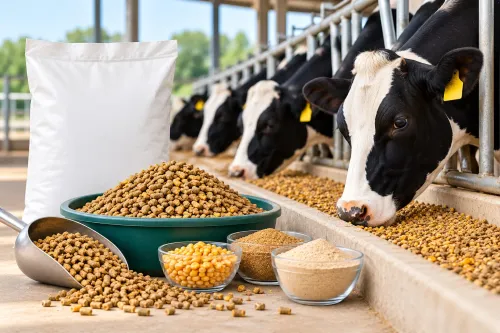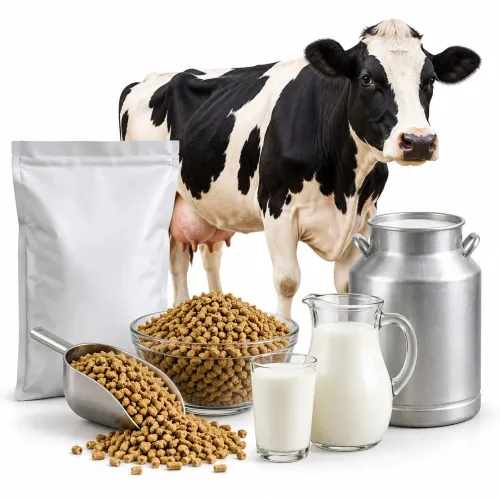
A reliable mineral mixture is more than a bag of calcium, salt, and trace elements: its value depends on elemental analysis, species-specific formulation, controlled intake, and evidence that the blend remains uniform and potent through its shelf life. By the end, you will know how to compare manufacturers, match a product to your herd and ration, calculate your order, and check each wholesale lot before use.
Key takeaways
- Ask for the manufacturer’s licence, batch release record, and certificate of analysis.
- Read calcium, phosphorus, salt, trace minerals, and serving instructions together.
- Match the mixture to cattle age, production stage, forage, and local deficiencies.
- Order from verified batch details and expected daily intake—not bag price alone.
What a genuine manufacturer is responsible for
A genuine livestock mineral mixture manufacturer owns the formula, production process, batch release, and technical claims. A trader may purchase finished goods for resale; a repacker may change the container or label. Neither role proves control over formulation, blending, or testing.
For a standard formula, ask for:
- Elemental guarantees for each declared mineral, not only the weight of compounds such as zinc sulfate.
- Incoming-material identity checks, quantitative tests for critical nutrients, and limits for heavy metals and other contaminants.
- Validated blending, particle-size control, representative finished-product sampling, and segregation controls during transport and discharge.
- A batch record, certificate of analysis, expiry or stability basis, retained sample, and documented investigation when a batch falls outside specification.
A custom formulation requires more than a new pack size. The manufacturer should record the target ration, forage or feed laboratory analyses, nutrient constraints, permitted ingredients, minimum and maximum inclusion limits, and the person responsible for final ration validation.
It should also use a written change-control procedure when a mineral source, carrier, supplier, or inclusion rate changes.
The manufacturer must supply a label and permitted-use documentation matching the destination market’s category, such as feed, feed supplement, premix, or feed additive. Disease-treatment or prevention claims can require a different regulatory pathway from nutritional claims.
A credible supplier also identifies the actual mineral source—oxide, sulfate, hydroxy form, chelate, or organic complex—rather than treating “organic” as proof of superior performance.
Which minerals belong in the formula—and how do you read the analysis?
Read the guaranteed analysis as elemental supply, not raw ingredient weight. “Zinc sulfate 220 mg/kg” does not mean 220 mg/kg zinc.
Look for calcium, phosphorus, magnesium, sodium or salt, sulfur, zinc, copper, manganese, cobalt, iodine, and selenium stated as %, g/kg, or mg/kg, plus the feeding rate and whether each figure is added or total content.
| Source | What it tells you | What to check |
|---|---|---|
| Limestone or calcium carbonate | Calcium source | Elemental calcium and particle size |
| Dicalcium or monocalcium phosphate | Calcium and phosphorus source | Both elemental amounts, not compound weight |
| Magnesium oxide | Concentrated magnesium source | Declared magnesium and palatability |
| Sulfate, oxide, organic, or chelated trace mineral | Different mineral forms | The guaranteed elemental contribution and permitted use |
Judge the calcium-to-phosphorus balance against the complete ration, not the bag alone. A high-calcium forage paired with a phosphorus-heavy supplement can create waste, while phosphorus-deficient forage needs a different specification; the target cattle and daily intake must appear on the label or technical sheet.
Minerals interact. High sulfur or molybdenum can reduce copper availability; iron can interfere with copper and zinc; excess calcium or phosphorus can reduce absorption of other minerals. Ask the cattle mineral mixture manufacturer to review forage and water analyses, then state the antagonist limits used in formulation.
A credible analysis also identifies the target animal—calf, dry cow, lactating cow, beef cow, or feedlot cattle—and uses consistent units. “Trace minerals added” is not proof that the whole ration supplies an adequate absorbed amount.
How do you match the mixture to cattle and avoid the wrong supplement?
Start with the animal and ration, not the product name. A lactating dairy cow, dry pregnant cow, growing calf, beef breeder, and feedlot animal need different mineral targets and daily intakes.
Ask a cattle mineral mixture manufacturer to match the formula to:
- Cattle type and production stage, including growth, late pregnancy, lactation, or finishing.
- Forage and complete-ration laboratory results, especially calcium, phosphorus, magnesium, sulfur, copper, and zinc.
- Soil history, because deficient or high-molybdenum soils can alter forage mineral supply and copper availability.
- Water analysis, including sulfur, iron, salinity, and nitrates; high sulfur or iron can interfere with copper use.
- The intended grams per head per day, not merely “free choice,” so the formula does not deliver too little or a toxic excess.
Do not treat every supplement as a daily mineral mixture.
| Option | Useful for | Limit |
|---|---|---|
| Calcium gel | A short-term calcium intervention around calving | It does not balance phosphorus, magnesium, salt, or trace minerals. |
| Liquid mineral | Controlled delivery through a measured system | Intake varies with water use, palatability, weather, and equipment. |
| Phosphate product | Correcting a diagnosed phosphorus gap | It may supply little calcium, salt, magnesium, or trace minerals. |
| Probiotic | Supporting rumen or gut management in a defined situation | It does not replace mineral correction. |
| Energy supplement | Adding calories when forage energy is inadequate | It does not correct a mineral deficiency and can distort ration balance. |
Choose the daily mixture only after identifying the missing nutrients and the supplements already in the ration.
How should cattle receive the product, and how much should you order?
Set intake in grams per head per day from the product label and the cattle’s ration, not from an unrestricted “free-choice” instruction. If the rate is absent, ask the cattle mineral mixture wholesale supplier for a controlled dosage and the basis used to set it.
- Count the animals in each group and separate calves, dry cows, lactating cows, and bulls when their requirements differ. Weigh or measure the amount offered, then record leftovers daily for the first week.
- Introduce the mixture gradually over several days. Start below the target amount, increase to the labelled rate, and avoid sudden changes that reduce intake or cause one group to consume the whole supply.
- Use a covered feeder with enough access points to limit competition. Check for caking, rain damage, contamination, and dominant cattle blocking smaller animals.
- If cattle refuse it, do not simply increase the dose. Check freshness, salt level, feeder location, forage change, water quality, and whether animals are sorting the ration; remove spoiled material and investigate the cause.
Calculate the purchase quantity with this formula: number of cattle × grams per head per day × days of supply ÷ 1,000 = kilograms required. Add only the measured wastage allowance from your records, then round up to the supplier’s pack size.
Give the supplier the animal count, intake target, supply period, and any separate groups before requesting a wholesale quotation.
What quality documents and supplier answers should you demand?
Do not release a wholesale lot until its Certificate of Analysis (CoA) names the supplied batch. A livestock mineral mixture manufacturer should also provide the manufacture date, expiry or retest date, net weight, storage conditions, recommended dose, and batch record.
Ask for these documents and answers:
- A manufacturing licence or feed registration, approved label, permitted-use basis for the destination market, and any applicable GMP, HACCP, or ISO 22000 certificate.
- Incoming-material identity checks, quantitative assays for calcium, phosphorus, magnesium, salt, sulfur and trace minerals, plus heavy-metal and contaminant limits.
- The batch blending record, finished-product sample result, retained-sample policy, and out-of-specification investigation.
- Shelf-life or stability data showing the test conditions, storage temperature and humidity, packaging used, and retest interval.
- A written complaint, recall and replacement procedure with a named contact and response timeline.
| Question | Dependable source | Label-only warning |
|---|---|---|
| Is it custom? | Records the target ration, forage analyses, nutrient limits, permitted ingredients, inclusion limits, change control and final-validation responsibility. | “Custom” means a new label or pack size. |
| What does the dose mean? | States grams per head per day or controlled feed percentage, with elemental mineral values. | Says only “free choice.” |
| What happens after failure? | Links investigation and recall to the affected batch. | Offers no traceability beyond the printed label. |
Alvid Groups is worth assessing by the same standard: request lot-specific evidence rather than accepting a product description or brand reputation. A cattle mineral mixture wholesale supplier that cannot provide these records is selling packaging, not dependable release control.
Related products
 | Veterinary Division Based on the image provided, Alvilite-Mix is a specialized veterinary nutritional supplement produced by ANI Healthcare for pregnant cattle and... View product → |
 | Veterinary Division The image features the Lacto Calcium line of veterinary liquid feed supplements, produced by ANI Healthcare. View product → |
Frequently asked questions
What is a genuine livestock mineral mixture manufacturer responsible for?
A genuine manufacturer controls the formula, blending process, batch release, testing, label claims, and technical documentation. A trader or repacker does not prove that level of control.
Which minerals should you check in a cattle mineral mixture analysis?
Check calcium, phosphorus, salt, magnesium, sulphur, and trace minerals such as zinc, copper, manganese, iodine, cobalt, and selenium. Compare declared amounts with the feeding rate and your cattle’s diet.
How do you choose the right mineral mixture for cattle?
Match the formula to cattle type, age, pregnancy or lactation, production level, forage, and any known regional deficiency. Do not choose by brand name or price alone.
How should cattle receive mineral mixture, and how much should you order?
Follow the label’s daily serving method and measure intake instead of leaving unlimited product without monitoring. Estimate herd size multiplied by daily dose and days of supply, then add a practical stock buffer.
Which documents should you demand from a cattle mineral mixture wholesale supplier?
Request the manufacturing licence, product specification, batch certificate of analysis, batch number, manufacturing and expiry dates, testing method, storage conditions, and a label matching the delivered product.
Related products
 | Veterinary Division LEEPHOS-XP is a high-potency veterinary feed supplement designed to manage metabolic disorders and enhance productivity in livestock like cattle,... View product → |
 | Veterinary Division Lacto Shakti is a veterinary nutritional supplement designed as a fat booster and milk yield enhancer for dairy animals like cows and buffaloes. View product → |
Keywords